After a couple years of trying to pitch lofty, abstract concepts for funding from the Smithsonian Tropical Research Institute, I changed up my strategy with great success! I went from rejected proposals such as “Give me money so we can do large scale exploratory performances with crazy technology in the jungle so that people can feel what it’s like to be an ant” to “Let me build an ant sensor” and surprisingly enough it got funded 🙂
As with all things in life, I realized that the reason I was having trouble getting funded last year was due to communication problems. No one should really be expected to just flat out accept big vague ideas that they have no real connection to what’s being proposed. So after doing lots of exploratory “Digital Naturalism” stuff last year, i decided it would be a good idea to take one of the projects that developed from this process, and present a very concrete idea that could gain traction among the scientists on the review board.
The basic concept
In the lab, we can track lots of ants with cameras pointed at the colony in a nice 2-dimensional plane. In the field however, the ants live on arbitrary geometric shapes- up the bark of a round tree and onto frilly leaves, for example.
While working with Peter, we had been adopting the computer vision techniques from the lab in field sites with little success. However, after our work designing, utilizing and performing with the technology together in the jungle, we were able to start analyzing our problem from the ground up.
For Peter’s experiments, we realized that we didn’t need all the data that the lab tools were working to collect like, ant position, unique ID, orientation. Instead what we could really use would just be something that told us there mere fact that an ant was there or not. In the little time that I had last year, I made a really simple ant-detector prototype. An LED gives steady illumination to a point on the tree bark, and a photo-resistor gives a reading of how much light gets reflected back. When an ant walks in front of the area where this simple sensor is pointing, it reflects the light differently and gives a different reading.
This early prototype showed lots of promise. Once implemented, we can potentially build cheap, sub $10 sensors that could be attached in arrays to arbitrary surfaces in the jungle. This would be a different means of tracking the insect movements with its own bonuses and limitations.
Minimal Information from single source: Ant Present, Yes or No.
Single Location, 2-dimensional
Multiple Locations
All Potential Technologies
Since I have learned the lesson over and over that everything will go wrong, and most things you assume to work will not, I came with several contingencies plans of different technologies which could also potentially work.
Reflected Light
Building more sophisticated versions in keeping with the original LED + Photoresistor sensor.
Modulated Light / Proximity Detection
This is the next step up from the original idea. The output light is pulsed, so the sensor knows exactly when to expect readings (cutting down on noise). Depending on how these readings come back, fancy sensors like the VNCL4000 (https://www.adafruit.com/products/466) can actually give distance
Optical Mouse Sensor
Right before I left for panama, Sparkfun started selling optical mouse sensors (https://www.sparkfun.com/products/12907). These chips are SUPER CHEAP ($1), and are actually high-frame rate cameras design to detect changes of movement in their visual fields. I ordered a bunch, and will try to see if I can rig them up to monitor patches of bark or leaves for the movements of any passing ants.
Electric Field Proximity Sensing
This option could be cool, because if successful, we could potentially detect ants within the trees themselves. This type of technology uses emitted electrical fields and senses any changes in the field strength it monitors coming back. Joshua Smith tested out a lot of this technology back in the 90’s with lots of sucess with Humans (we are big conductive blobs of water). In order to detect ants, this might not work at all (they are small dry and barely conductive). But if all other methods fail, this could be a cool thing to resort to.
We are recruiting field biologists for the upcoming Transcontinental Hiking / Hack. This will be a 9 day hiking workshop through the Panamanian forest going from the Atlantic to the Pacific taking place from June 26-July 5 2014.
The primary goals of the project are to:
Design technology for studying animal behavior in situ.
Conduct a Basic Biodiversity Survey of the Area.
Raise ecological awareness
Chosen Applicants will be compensated with:
Free Food
Transportation for individuals already located in Gamboa Panama to the start of the Trail, and from the end of the trail back to Gamboa. (You need to arrange your own means of getting to Panama).
Electronics
Training in basic programming, physical computing, sensor creation, and interaction design
Applicants will be responsible for:
Helping design and carry out the scientific survey
Documenting the Trip
Carrying Gear
Participating in the proper training before the trip (Meetings, emails / 1 workshop in Gamboa, Panama)
Participating in the mobile workshops during the trip
Participating in a documentation workshop after the trip
We have 2-3 slots available. Anyone is welcome to apply by emailing: andy@quitmeyer.org . Put “Hiking/Hack” in the subject line, and describe why you wish to join our crew.
This is part of my own research in what I call “Digital Naturalism.” I seek to understand how we can develop technology with scientists for the study of animal behavior in natural environments. I seek to design technology for the full ethological process, from early open-ended exploration, to rigorous experimentation, to embodied and interactive dissemination.
In wrapping up my 2013 field season, I challenged my partner Peter Marting to express his research as a performative love story. In just a week, we managed to put together a 30-minute play featuring dozens of actors and audience collaborators, costumes, and an 18 foot long Leaf Cutter ant puppet.
I have never been really good at music, but I have always been compelled towards it. I remembered hating being forced into band in 6th grade. Music did not make much sense to me. You were given a list of absolute commands, and then judged upon how well you could become a robot that repeats these instructions. To me, this seemed like an alright thing to do for a little bit, just to get an idea of how frequencies and rhythms were encoded onto paper, but once you had that part down, it seemed like the appropriate thing to do would be to program a synth or computer to perfectly replicate whatever you composed. The playing of the actual instrument itself seemed a flawed a pointless pursuit to me then. I felt that the only value in making music could come from composing new songs. However no one could really describe what the true point of music was anyway. Other arts seemed to have absolute value at least in representation; you could paint a picture, or make a sculpture to obtain a lasting record of parts of the world. There was nothing we were explicitly replicating with music however.
Experimental Musical Instrument by JPOM (“Mushy Lightning”)
Music had no explain-able higher purpose. You did things because they sounded good, and things sounded good if that’s the way we were used to hearing them. It strictly relied on following conventions agreed upon unconsciously by our culture. Particularly when I was younger, this notion of following conventions purely for the sake of appreciation by others seemed to be the antithesis of creativity.
I still appreciated good songs and secretly admitted to myself a fondness for popular catchy tunes, but the schism between analytic and emotional appreciation of music just drove my curiosity further. I sought out music that broke conventions and did strange or discordant things that you could grow an appreciation for like Zappa, Aphex Twin, John Cage. No matter what, though, I could still get a terrible song by Train stuck right in my head.
So I had this slow burning question that I always carried with me from a very young age:
What is music?
What is its function? How does it work, and why do we enjoy it?
The first thing I did when I moved away from home in High school was create a band to violently deconstruct music (http://jpom.bandcamp.com/). Maybe by stripping it down, I could finally see the naked truth of music.
Cover of one of our first albums
Even the band’s unpronounceable and unreadable name, Ju9mp_ily PLant Orgasm > Mayhap, was developed for cognitive jamming. Scientifically speaking, the methodology involved to pursue this inquiry involved taking one assumption and then applying one algorithm.
Assumption: we were the best band on earth, and thus had unlimited creative freedom to define an artifact as “music.”
Algorithm: if I could identify a musical convention or standard, I would try to do the opposite.
A lot of this is your standard teenage contrarian-ness, but I very consciously always tried to channel this push to inversion towards its limits in investigation and general weirdness. The first thing to destroy was any pre-determined roboticism about creating music. So no rehearsing, no aiming for particular notes, no written poetry, just fill a room with energetic people, hit record for a certain amount of time and accept what results as the purest of music.
After a while I would identify other commonalities in music to attack: the proper way to play instruments, non-disgustingness of lyrics, types of juxtapositions of content and form, and standard components such as rhythm, melody, and tempos. We also explored all the satellite activities that constituted being in a band such as making music videos, producing records, battling other bands, creating the official soundtrack to major motion pictures, and even starring in our own documentary about the prices such an amazing band must pay for fame.
After exploring one factor thoroughly in experiments, such as the point of percussion in a song, I would relax the constraints on the banishment of this particular feature, and allow a song to have normalcy in this aspect while I experimented with some other part of music. Towards our later albums the contrarian-ness became more subtle and songs started to almost sound like real songs as I focused on attacking more and more specific parts of songs. For instance, the impetus behind the “Pee Pals” song was to see if I could make a simple song that people could dance to the beat whose content was also about something less appealing like peeing all over the dance floor. And this all started as an attack on the common reference in so many songs to the roof or ceiling as holding down the dancing. So in this song I tried to paint the picture of the roof holding in everyone as they literally drowned in their own piss as the dance room filled with party urine. Like all my songs, this exact sentiment may not have come across, but this manic process always did lead to something.
This still never directly answered questions for me about music as a whole, or even about this specific component (i.e. “oh, songs need percussion because of X”), but slowly I began to tacitly understand the impact of certain conventions. In fact, it was becoming clearer and clearer to me that music was a recursive set of conventions scaffolded deep in the trenches of history beyond memory.
Over the 15 years of this thought and analysis, I have currently arrived at two definitions that have been bouncing around in my brain.
Now prepare for conjecture…
Biopoesis
One of my earliest definitions for stating precisely what music is came to me at a Ladysmith Black Mambazo concert.
The group danced in front of the audience, and followed and played with the musical rule-sets. Musical algorithms developed amongst themselves and the unconscious genetic and cultural regulations governing our thoughts and bodies. As they twisted and undulated, and non-verbally encouraged the rest of the audience to clap along, I was struck with a vision of the creation of life. The arbitrary rule sets were no different than the arbitrary universal constants set forth to govern the universe at t=0; the entangled patterns that repeat themselves in these musical rule sets were no different than the forms, and behaviors that have distilled from the chaos according to the universal laws. Music was biopoesis. Music created the simplest version of “life;” a single note resonating against the void. The persistence of a pattern throughout space and time could serve as the simplest definition of a “living” entity for me, and music was the conjuring of these patterns. At a concert everyone participating is aiding in the birth, exploratory life, and eventual death of a living creature.
Ego Solvent
The other definition upon which I arrived for music was an oblique one. It defines music indirectly by describing the conditions for the experience of it.
My thought is this:
Music is what you receive when you are no longer an individual. Static and discord are only felt when a thing exists as an single organism. Musicality is what your bodily cells live in every moment of their lives until they die or turn cancerous (perhaps in cancer a different tune takes over, perhaps the biological equivalent of getting a terrible Coldplay song stuck in your head).
This definition had been with me for several years, but did not manifest itself as well into words until I made a concert video for peter and his friends in their band Ptarmigan. I had them perform an acoustic concert with Peter’s research animals, the Azteca ants living in Cecropia trees.
[Video of Ptarmigan’s performance in the jungle with their research creature/collaborators]
Watching them follow the secret patterns governing the actions between them (both the band and the ants), solidified for me that what we call music was the experience of living as a larger entity beyond our “individuality.” Also with things like Mirror-Neuron theory stating that our brains actually enact what we see others do, the idea that listening to music is cognitively similar to playing it removes a categorical distinction between musicians and audience. Thus living in music is the same as living in a superorganism. Living in static is living as a solitary singular creature.
To find the atomic organism at a given moment, we travel up levels of organization until the music experienced starts breaking down.
Music is the dissolution of identity. It is ego solvent.
It may be communication without meaning. A meaningless medium.
When social insects like honeybees slowly evolved an increasingly tight social co-dependence, the musicality of their everyday encounters would be increasing. Evolution is the ultimate composer, crafting species specific songs over millions of years. Individuals merge identities not through explicit goals, but through a developing drive towards a certain sought after harmony bred into their brains. The ant collects and returns food to the nest not because it has a stated intent of helping the group, and perhaps not even because she herself is hungry, but instead because she is caught in a musical rapture.
Brains are little more than multi-dimensional harmonic oscillators shaped by adaptation and genetics. They are software both learned and burned-in. These oscillators respond to our environment and actions, and when our behavior shapes the external world to vibrate our brains correctly we experience music.
Dissolution into the Conjured Being
I think both theories are interesting to ponder, both music as the simplest living creature, and as superorganismal glue. They need not exclude each other also. Perhaps music is a creature to which we can become a part. Music can be the female anglerfish, and by following its siren spell, we the male anglerfish attach, dissolve and become just an additional appendage of this larger animal. The function of music as an art can be to let us create new forms of life, and leave ourselves to become part of this new creature, if only for a brief period.
The male anglerfish attaches to the female during mating and then dissolves its entire body leaving little more than an appendage of gonads for the female that produces sperm.(from letvc.com)
Daan and I make it back to the main labs on the island to meet with Courtney. I chat with her about her research with Leaf cutter ants and computer vision. We were supposed to meet in the lab, but suddenly before my arrival, the ants decided to get moving, and she had to hurry up and capture their activity in the field. She wants to see the effect that an additional cache of leaves will have on the Atta’s foraging. That is, she sets a big pile of pre-sliced leaves next to a foraging trail, and sees how this changes what the ants will do who are marching up to strip the trees. She wants to see if their response to this cache will also be affected by the blocking of more ants returning with leaves. The idea is to see if the ants in a colony will start using more of the close by piles of “leaf-reserves” if the incoming stream of fresh leaves dries up.
She blocks ants returning with fresh leaves by placing large U-shaped hunk of mesh over their path which lets ants through but not ants carrying large leaves. This ingenious intervention preserves their same pathway on the ground but just prevents the fresh leaves from getting drug in.
On the way up to visit her, a playful group of spider monkeys play in the low trees just a couple meters above our heads.
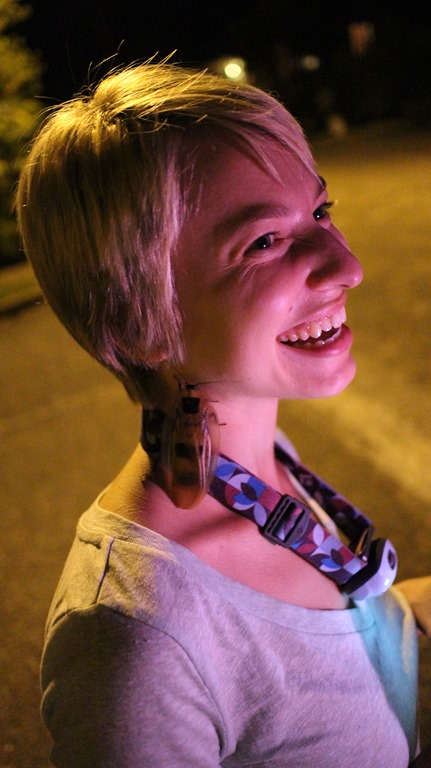
We eat and see that night’s BAMBI talk and then gather participants for a special BCI version of the firefly game. A good amount of people wimp out, but we have an awesome group of super cool people joining anyway! This time we play in a slightly more urban environment. I thought it might be too easy in this format (not in thick jungle), and that this might break the performance/game. In reality, however, these more open spaces (yet still very dark) create a very compelling, fun game. In fact, since the fireflies themselves don’t have to deal with the drudgery of walking through tangled vines on the forest floor, and instead float effortlessly about, this part of the simulation may fall closer to the real experience of the fireflies.
The main things that keep breaking in the game were the solder joints on the wires (especially in the mouth pieces). This is also the first time we wore the costumes on our ventral sides which reduced the amount of times you would get unknowingly snagged on things.
After a couple of rounds we recuperate in the visitor’s center before hiking out with the group into the woods to hunt for luminescent fungi. It is tricky to find because in the light there is absolutely nothing to see- No mushroom body, or slimy growths. You have to let your eyes adjust, and suddenly, what you thought was a speck of light filtered from the moon down to the forest floor grows brighter and brighter. Soon you see that the ground is littered with sticks and leaves infested with the fungus.
We set up the camera and take a couple of long exposures. Really long exposures. The glowing is very faint, so we crank the camera open and let it sit for 30 minutes to an hour at a time.
Meanwhile we set up these amazing tents called “Hennesee Hammocks.” They are fully covered, uterine-like sleeping devices. You string up these sacks between two trees like a normal hammock, and stand underneath. Two velcro lips open on the bottom and you are able to sort of reverse-birth yourself into the sack, and it automatically seals behind you.
I drift off to sleep while the camera seeks out photons from the fungi. The tent/hammock surrounds me, a mosquito prophylactic, that still gives the full pleasure of immersion in the jungle.
(these tent things are prone to flowery euphemisms)
Up at 5am to fix some quick electronics for the firefly costumes. Print off Posters for peter’s performance, hang them up. Grab my gear and hike to boat to hopefully catch the 7:15 for BCI.
Meet Daan there who takes me on a whirlwind tour of the island. First I shadow her methods in her Forestry Management research. She sets up camera traps all over the island jungle to survey the wildlife rooting around. This requires lots of maintenance for the cameras as well as shifting and replacing cameras to catch activity in new spots. Also it takes a shit ton of batteries.
I try to learn about all the quirky and practical problems of doing what, in principle, seems to be a very straightforward task: Put cameras in jungle.
One of the biggest parts seems to be finding a good placement. You need a correctly sized tree to attach onto first of all. Next Daan tries to get into the mind of the animal. She walks around the chosen tree and searches for pathways that an animal might take when walking by. Then she orients the camera correspondingly so that it correctly sets off the motion trigger. She can put the camera into a test mode where she then physically crawls (or in this case, sort of apes around) in front of the camera in order to test the camera’s range.
Concerning things that can go wrong with the cameras are mostly on the electronic end. These camera traps seem to have few problems with the lenses, or being broken into. When planting cameras in more publicly accessible areas she does need to put unbearably heavy locks onto the cameras to stop poachers from stealing them, but other than that physically the cameras are quite solid devices.
Electronically, there are many problems. They are often running out of energy at different rates which screws up her schedule. The displays get corroded by the moisture, and sometimes the motion trigger goes berserk and fills the card with meaningless photos.
Our planned route today includes stops at several cameras around the island, the careful collection of a moth that had succumbed to a crazy tentacle fungus, and a stop at the remains of one of the largest trees in the world.
We have a lovely picnic under the moth’s H.R. Giger – styled remains. Sitting quietly in the forest we hear growingly braver stirrings as the creatures adjust to our presence. Different animals around us which remain unseen stir about more frequently in their quests for food, sex, and comfort. The forest awakes around us in this midday-hour culminating in a massive roaring of the howler monkeys. The howling signifies a sort of orgasmic release which then silences the building cacophony.
Following her GPS back in a loop we stopped by a disheveled clear patch in the forest. Limbs were strewn about in this disaster zone, and the eerily cleared space looming above was penetrated by a sharp, snapped obelisk.
Until two weeks ago there stood the island’s famous “Big Tree.” The massive kapok tree held a 13 meter diameter supporting massive, spreading limbs covering all of the nearby jungle. As the Smithsonian noted, “This was by far the largest crown known on the planet for a tree with a single stem.”
I had been to BCI last year when it was still standing, but Peter and I got a bit lost walking around and never found it. It’s fun to get to clamber about parts of the tree that were just previously inaccessible. Gravity and decay brought them down to sate our curiosity.
Dad takes off from Panama, and I head to the weird zone between the city and Gamboa along the canal to get my final shot in my Rabies series. Had to erase part of my prescription and write in a new date because I think the nurse had gotten it wrong. It’s a tiny bit scary considering my prior reactions and just manipulating the hospital workers’ decrees in general, but everything works out fine. Ummat on the other hand became super Ill. We had to drive him to the clinic, and they gave him some antibiotics, but in two days his condition went back worse. Poor guy being sick in the field is terrible, but now it looks like he will be in the hospital for quite sometime. (Update: 15-7-2013 They still haven’t figured out what is wrong with the guy. They had been thinking rickettsia, leptospirosis, and several types of meningitits (including fungal meningitis), but haven’t nailed it down. He had brain and liver swelling, and all they have been able to do is treat the symptoms.).
Peter and I uncover an electronic mystery during the rest of the day which we relegate to digital crafting. We are able to send communication wirelessly and drive a servo from a soldering iron.
Peter starts working on flick-o-matic 2.0. He’s coming up with growingly crazier designs to meet his goals of delivering fully automated powerful thwops against the tree. What started last year between us as a simple idea of programmatic smacking device, grew into more specifics as we developed the device with his experimental requirements. He needs the device to hit the tree with the following constraints:
– Deliver a consistent, hard enough wallop to be felt by the ant colony many meters above.
– Repeat this hit 10 times consistently and then automatically stop itself.
– Be blunt and soft enough to not bruise or cut the tree (stop it from releasing chemical stimulants in the tree sap)
– Be able to be bounced around in the back of a truck driving down a rough jungle road
– Be easily positioned near the tree, but only touch it when the experiment starts (even minor brushes with the tree can screw up the experiment). Peter waits at least 30 minutes after an accidental knocking on the tree to restart the official trial.
PETER: “I find myself thinking in new ways of the materials I have available. Like I use these things (plastic collection vials) for everything. I wonder sometimes about how if I had a different workspace with different materials how my designs would appear then.”
Barrett Klein, the model-making wizard and insect insominator has arrived back in Gamboa. We have all been eagerly anticipating his return, as this will kick off a new interesting experiment: parallel sleep study between an invertebrate and a vertebrate. The vertebrate will most likely be a bat, since the bat lab is one half of the grant, but exactly what type of bat is still up for discussion. For the spineless participant, Barrett makes sure to have everyone think in very broad terms, before mentioning a couple of organisms with good potential for the experiment.
At the beginning of the meeting Barrett describes the approaches we can have with this study. Sometimes you can plan plan plan, and work out all the meticulous details of your project ahead of time. This can reduce later stress, improve efficiency and precision of your experiments. It also tends to work in highly controlled environments with heavily studied subject animals. He says that unfortunately we have neither. Here, instead he suggests that we use the Tinbergen approach. We begin experimentation, but always keep one eye open for oddities in behavior. It is these unusual bits of phenomena which can lead to veins of gold in research. He instructed us to always “keep the tinbergen in you to mine for the greater gold.”
Barrett is very excited and makes us all food while we wait. The discussions are always fast and fun with him. Later in the evening I join Michelle from the bat group and Ashley, who will make making up part of the invertebrate testing team to test out some modded gopro cameras from Bill Wcislo. He had the cameras sent away to be modified into IR cameras for recording high-speed video of creatures moving around at night. In theory they were supposed to remove the normal infrared filter built into most cameras, and then add in a visible light filter. We were going to see if we could use it for recording the bats swooping down to catch the robotic frogs in the flight cage. On the way over, we found a huge, beautiful roach. It fluttered softly in the air and was easy to catch. Its outer wings were a stylistic transparent color.
We were having problems with the new IR cameras. It seemed like the IR floodlights were far too dim. When we looked at my other, unmodified gopro however, we could actually see everything fine. Possibly the IR floodlamps were too short of a wavelength to get blocked by the normal gopro, and not long enough to make it through the newly added visible light filter of the modified one. This was good news for being able to record with my cameras that we already had, and bad news for Bills.
Field day with Peter and his Band. They came into town from St. Louis Saturday evening prepped for the Neon Party on the ridge. Today they are working with us as field assistants who happen to break out into the occasional jam. As I ride in the back of the truck, testing out living inside the new bio-survey method “Ladder on a Truck” with Evan strumming the guitar, I have the realization that this moxy adventure could be the premise for a children’s animated television show from the 70’s. Crazy truck of scientist-musicians rolls through forest, experimenting with ant-plants and taking time out for musical interludes.
It was a luxury having so many extra hands available for carrying out the experiments. It also gives those great recurring instances where you have to explain to a whole new group of people on the spot exactly what it is you do. The restatement of one’s goals and ideas seems to sharped and sculpt your arguments. It runs an evolutionary algorithm on your ideas, and it chips away at the bits of the iterations that fail. But like evolution, it only gives us a locally optimal solution. Evolution will only give the laziest solutions to continued existence, and reinforces the situation a thing finds itself in from previous investment. The process will reflect its embedded environment, and dig the solution deeper and deeper, until entrenched. This is why it might be useful to carry these ideas as they evolve to different mental environments. Keep it flexible, robust.
Had the guys do an acoustic set of a couple of their songs with Peter’s subject animals. The concert featured just a guitar, some rocks, and a cecropia tree full of azteca ants for percussion. Their performance ended up being limited by the aggressiveness of the colony.
We also wonderfully weirded out some groups of other scientists who happened to be passing through in the jungle. Evan and I also testing out a sprinting, moving, musical performance with guitar and harmonica while jogging down pipeline. We all do some jungle vine swinging and then catch Marc Seid’s Gamboa talk at 4pm about various different projects involving insect brains and addiction. The newly arrived Barrett Klein is also in attendance. I give him copies of my field books and he loves them. He says he is always looking for things to show his class about alternate ways of doing and presenting science.
Peter’s jungle ladder has been capturing my imagination more and more. So much so, that I even wrote a poem about it (adopted from WC Williams’s “The Red Wheelbarrow”). It is a simple household tool, but completely necessary for Peter to gain closer experiences to life with the Azteca. The trees and ants are trying their best to keep others from experiencing their world, and the ladder defeats them. The way we carry it in his truck makes it collect all sorts of interesting debris as we drive through the forest, but because it is in the back, this process remains mostly hidden to us. There’s not much logically missing from this process when we think about it abstractly, a ladder sticks up and waps all the branches and leaves that hang down. But it is such a dynamic system, I have been wanting to feel it more deeply and experience it from within. It also didn’t hurt that the truck was full on the inside anyway. So I set to surf the truck down pipeline and put myself directly in the ladder. Something stung me on the eye, I got slapped around something fierce, and I got bit by dozens of different creatures. It gave me something I am not sure quite yet how to express.
[The blog post in which I rapidly transcribe many half entries scrawled on bits of paper]
Bats are quite often agents for spreading rabies. So, to be safe, any bat researchers that handle them need to get their full vaccines. This is a series of 3 shots taken over 3 weeks that can cost $1000-$1500 in the United States. In Panama, however to deter what could maybe be a very serious hazard to public health, they offer this vaccine for free. So I am off to get myself free super-powers!
The needle is longer than the radius of my arm and it goes straight in, so I don’t understand how it doesn’t hit bone. I am fine for the first day and a half, but slowly get incredibly dry and sore throat.
Marc buys us Palm fruit on the way back. Tastes like southern boiled peanuts but much larger and substantial.
Begin designing with Toni some exploratory tools for research. After each design we do a little physical performance to act out how our code would work. She is impressed with how effective this technique is for making you think about the weird non-obvious assumptions you make in programming. We change a part in our design, perform the new process, change, and iterate.
They have a tradition of naming new bats after fellow researchers who have left. So today we processed a May, Florencito, and Molly bat. Last year May and them gave me the honor of naming a little “Andy” bat after me. Marc Seid says that bats are real outliers on the size to lifespan chart. For how small they are, compared to other mammals, bats can live a super long time. More than 30 years old seems to be the consensus around these parts. It is fun that this little andy bat can still be flapping around in these forests when I am 60 years old. Their heart rates are crazy too. 1300bpm in flight and several hundred bpm while resting. These rates would make your heart explode.
The May bat’s transpondering failed, but we already registered her in the permanent records. We will forever keep the May bat’s punchings and record on file, we will never know if we catch her again. So now due to a physical error, this bat will persist eternally under the “May” identity in a bureaucratic limbo. She is now a phantom of information penetrating the forest.
We go and process the bats out in the field. Strolling around marc tells me about some research that wasn’t exactly quashed, but was put off indefinitely because it went against what an expert in the field had purported to be true. This is the more sinister way science can be manipulated. Not outright rejection of non-canon, but overall doubt in the researcher and peers about contradictory findings.
Whipped out some better bug tweezers for taking out parasitic specimens for the bat people. I am not the best biologist, or designer or researcher or artist or anything, but damn if I am not good at carrying around tons of equipment that might be useful. I am like a hobo hoarder of potentially interesting tools. I have found that by not every truly knowing what I am doing, I tend to be specially prepped in a lot of situations. I can be the contingency guy.
///////////
After crazy day of performance art, hiking, designing costumes and all night neon party out in the field with Santi and Toni.
Pass Peter and his band in the field. They take a rental car out on pipeline and rip off the back.
They’ve been hunting Trachops without results for many weeks. Now suddenly stumbled across a nest of ten in a tunnel. Most are bats never even caught before.
//////////////
I hop the 4:45 am bus to go to the airport. Waiting outside in a tornado of sex. The leafcutter ants are having their nuptial flights all around me, and the street lights are confusing their orientation, working as strange attractors to the orgy clouds around me. The males are the size of testicles. You can hear them smashing together in a fury. I step into the dark bus, a diablo rojo. This particular one of these blinged out virginian school buses is lined with LED strips and has a large disco ball up near the driver. He steps out the bus and pees.
By the time I set foot in the airport my throat is on fire. The rabies vaccine is reacting badly. I get a sample of whisky from a girl selling it, and use it to gargle in my throat. Numbs it a bit.The lady sitting next to me waiting for the plane says that it is too early (6am) to be drinking. I have an achy flight to San Francisco. My foot is also infected from a thorn that I tried removing in the jungle. It throbs along with the main character’s infected foot in the book, “Oryx and Crake” that I finish up on the flight. I get to SF before Kitty. The air conditioning is freezing. I crawl into a large plastic bag and sleep on a bench waiting for my lovely wife.
For my second “Digital Naturalist” collaborator, Toni, we met up late one night to discuss which famous work of performance art she wanted to reenact in the jungle. We discussed Joe Beuys, Yoko Ono, (she brought up Abramovich’s piece with the gun), and more of Kaprow’s happenings. She really enjoyed reading about the piece for “Raining” where various objects in the world were painted and then waited on for the rain to wash away (pictures of boats along gutters, trunks of trees painted red, people’s naked bodies). She eventually chose an adapted, and condensed version of Kaprow’s “Soap” to perform where we would cover our bodies in Jam and wash them in the river.
(video documentation of the entire performance)
My goal with these performance art re-enactions was to expose my scientists to different modes of experiencing the strange worlds they encounter everyday in the jungle. Our perception and learning is not absolute but rather state based. The things we pay attention to and the way we comprehend these interactions are steered by our physical and mental states. The insects you notice while walking through a jungle may be different when walking through that same jungle naked and covered in jam.
Another reason for these happenings is to provide and opportunity for the scientists to stand back and reflect on their own practices as these strange performances with animals. Casting this frame of “performance” around the scientist’s work allows him or her to sort of see their own methodologies with new eyes, and pay attention to aspects of their interactions with animals which may have been taken for granted, or simply adopted flatly from standardized ways of experimentation.
For Toni, she saw the performance as a way to explore the irrational in order to clean out the logic machine operating within the everyday scientist. This “logic vacation” let the scientists attempt to let down their guard of incessant meaning-making. It was a way to wash the mind and restore its logical gates to their proper functioning. I argued along with this that too many scientists were always worried about the “meaning” behind doing certain actions, when in fact, meaning making is the core-automatic process of our brains. Our brains find meaning and connections between all the random bits of stimuli we receive, whether these connections make sense or not. We find faces in rocks on cliffsides, and claim instances of Deja Vu when two events from of all the sensory data we happen to take in during our lives intersect. Instead I argue that novel action, not meaning is what’s rare to find in the world. Borrowing from Robert Crease’s work in his book “The Play of Nature” I claimed that the way to discover interesting new behaviors is by performing new behaviors in the world itself. The phenomena we then call forth will be then put under the lens of our brain’s semantic scrutiny.
Like all the performances, I first created engaging posters to hang up around the Smithsonian. This served several purposes:
It prompted curiosity about our research.
It let us reflect and abstract upon the core principles of our performance to be.
It kept my scientists committed to their performance. In this tumultuous world where daily routines are shattered and driven by the weather or wills of the animals, these posters served as temporal staples; locking in their commitment to the strange or odd act they had agreed to.
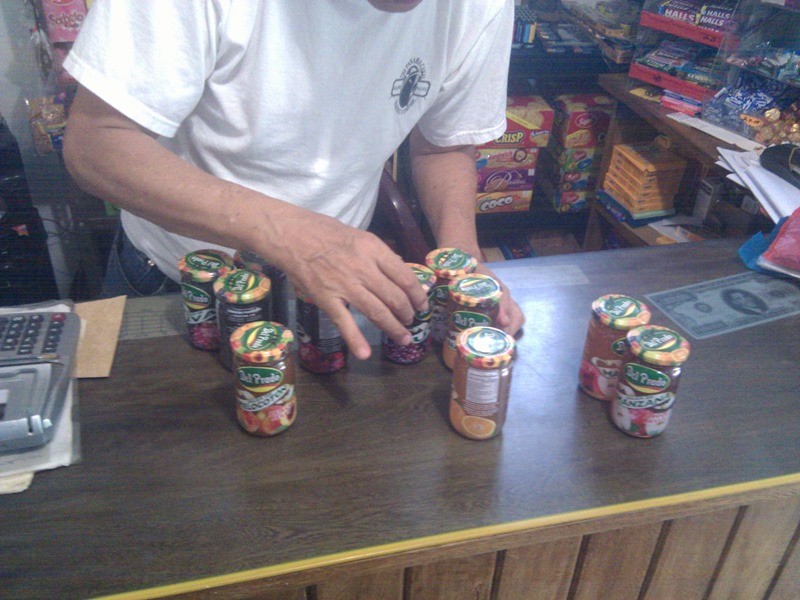
Tienda guy’s wife had an accident on Friday and the shop shut down. Not only were we worried about her health, but to a lesser extent, we also realized that there was no other source of large amounts of jam within miles.
So I got up early on the day of the performance and showed up at the little shop as it opened to make sure that if it was not going to open, we might still have enough time to find a ride into the city and secure the jelly. Luckily everyone was fine back at the Tienda, and I bought ALL of their jelly. (After buying all their ice another day, the Tienda guy is starting to get a bit weirded out).
Toni and I prepped before heading out. We finalized our performative script for the day. She wanted us to:
Cover our bodies in Jelly
Hike through the woods down to the waterfall on Mendoza River
Bathe ourselves in the waterfall and pool
Hike back
So that’s the invented ritual we aimed to follow. Like how Schechner defines a performance as “ritual modulated by play”, -how we would adapt this theoretical model of action to the real time and place became the actual performance.
It rained a ton, which made the normal way of walking up to the waterfall (along the edge of the river), quite impossible (especially if we wanted to keep our jelly on). The rain also kept the insects at a minimum which we had anticipated being one of the main experiences of our journey. Instead one of the main things we noticed were about how a body, unencumbered by backpacks and clothes, can move through a jungle. Peter noted that he was able to sneak up on a deer due to his ability to move ultra-silently. The jelly served as a way to highlight all our intereactions and brushings against different insects, dirt and vegetation.
Sometimes the steepness, or thickness, of the terrain would force us to walk through the river, and the jelly made you perpetually conscious of exactly how deep you had entered this fast-flowing flooded river.
The sweetness of the jelly came as sudden suprises. During the trek, little bits would drip with your sweat and land in your mouth, causing quick explosions of rare flavor to take precedent over your focus.
I also took the opportunity to physically emulate the actions of the primary hero of my research, Niko Tinbergen. Here’s a candid shot of him doing fieldwork out in the Netherlands paired up with a shot of the fieldwork of my own.
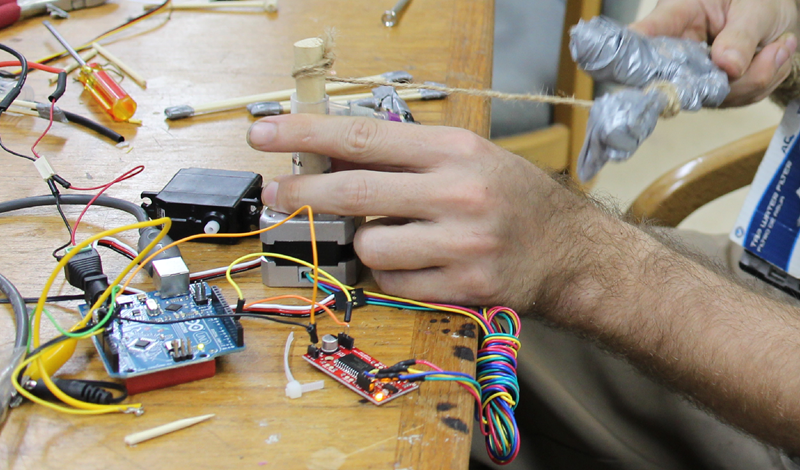
Here is my first electronic creation – moisture sensor that can make a servo move with a different speed relative with the soil moisture… device that no one can survive without!
But before to reach these high technological goals I first had to learn few more simple tricks.
My first step was to build circuit that make LED turn on. Then we learn how to use arduino and so to control the electricity and make the LED blinking with computer code. Then we programmed servo to move on its own. Finally I looked up how to make a moisture sensor circuit in Google and I hooked up the sensor to the arduino and the servo and programmed so the sensor make the servo move differently.
Here is the code you can use to build it by your self.
const int VAL_PROBE = 0; // Analog pin 0

const int MOISTURE_LEVEL = 250; // the value after the LED goes ON

#include <Servo.h>
Servo myservo; // create servo object to control a servo
// a maximum of eight servo objects can be created
int goup =1;
int led = 13;
int pos = 0; // variable to store the servo position
void setup() {
Serial.begin(9600);
myservo.attach(4); // attaches the servo on pin 9 to the servo object }
pinMode(led, OUTPUT);
}
void LedState(int state) {
digitalWrite(13, state);
}
Doing any performance is much harder than you ever think. Our plans were set and Peter and I joined up to gather morning coolers before La Tienda Opened. 7am Grab the super nice volunteer Dallas along the way. It is crazy early for a bat person.
To give my digital naturalists some practice at alternative forms of performance, I am having them recreate famous performance works in the jungle with their creatures. The first one to go was Peter, who from a list of famous works of performance art chose to reenact Alan Kaprow’s piece, “Fluids.” In “Fluids,” Kaprow built large structures of ice around LA and left them to melt. We were going to try out the same thing in the Neotropical rainforest. A place where ice scultpure art is not only uncommon, it actually introduces a whole new state of matter to the animals that typically only live in the thick sweltering heat of the jungle.
Scene from Kaprow’s Original “Fluids” work.
We noticed the gas levels in the truck were dropping rapidly though. Suspected a leak. Needed to drive into the city to the nearest gas station (20 miles away). Caught in Traffic, gauges still dropping. Pulled into station with needle bottoming out. Fill it all the way to the brim with diesel, but it only takes 5 gallons. Gauge must be faulty. Hurdle 1 done.
Get to La Tienda. Guy seems a little weirded out that we actually came for the “mucho mucho mucho hielo” I requested earlier in the week. 60 bags total. Loaded 40 into coolers and my newly emptied out pelican cases. Wrapped the remaining bags in a white tarp (that Peter used for harvesting Aztecas from Cecropias). KC saw us loading ice and decided she was game to join the crew.
Loaded first installation at the gate to Pipeline road. Met Sunshine’s group there with us. Explain concept and move a fallen tree a bit. They seem to actually like the concept.
Get to our first cecropia tree. It cannot be one for Peter’s official research, because that would screw up his longer term experiments. Pile the ice around for installation #2 and freak those ants THE FUCK OUT. Peter and I have never seen them so angry, and come down so far from their nest near the top of the tree. They seem to be sustaining the anger longer than with flicking or tapping the tree also. Want to get some gorgeous dolly footage of the installation, and realize the dolly is gone. Maybe left it at the Tienda?
Drive back to town, setting up installations along the way. This time around a foraging leaf-cutter trail. Drop off KC, cannot find dolly. Maybe it bounced out of the truck? Drive back to dallas who has been performing a manual time-lapse for us and guarding the tree from the rain. No sign of camera dolly. Bring him lunch. Eat and discuss, and suddenly he has a batmeeting he needs to go to. Peter leaves me at the cecropia ice installation, whose inhabitants are still attacking full force (for over 3 hours by now).Time passes trying to get aesthetically pleasing macro shots of Azteca performing unseen behavior where they shake or pull their frozen compatriots from the icy depths. They are able to revive many. The ice is taking much longer to melt than thought.
After an hour, Peter pulls up in truck. He saw my weird, large mammalian body sprawled in the road and thought I was a tapir. He now has Marc Seid with him and three interns. They are happy to report that they found my dolly! They pull out a brown metally mess. After having driven over it 4 times ourselves, and with at least 3 other run overs by other trucks, it had peeked itself out of the deepest puddle on pipeline. Nothing was bent, only one simple screw had come off, and after I rinsed off the mud and re-lubed it, it worked good as new!
Marc became fascinated with our ice installations. He gave me the high compliment I had been looking for with all this craziness: “This is …. not stupid!” We studied the deformations and restructuring of the foraging leaf cutters in close detail as they responded to this strange stimuli.
One installation, near the river, revealed to us, the vastly different heating and cooling properties of the leaf littler and hard rocky surfaces.
Didn’t wrap up until around 7pm. A good solid 12 hours out in the field. The azteca and the ice were still battling as we left.
Peter and I have hiked out to his secondary field site down old Gamboa Road. Unlike pipeline, this old road is barricaded, so we cannot drive our equipment down to his trees, and instead have to take his cameras, tripods, and full sized ladder through the jungle and up a creek. We set up the first of the days experiments around 8am. Howler monkeys lazily gaze down upon us. Probably resting after all the sunrise screaming. My second official day shadowing him, and he has already worked many of the kinks out of his process. All the cameras are charged, no tripod switching, timings are all down pat with additional buffers for recording ant movements.
Tested out my macro extension tubes on Peter’s 100mm canon macro lens. Makes for double mega macro that’s also super hard to use in the field. Managed to snag this pic however, resting the camera on the top of my boot.
Checking in with him about his journaling, and he reports that it is going well. In particular he liked one of my guidelines in the journal where I have him act out a portion of a performance that he had witnessed that day. “It always makes me think of new things when I actually perform. I think about specific parts about how the antennae move, or that person acted which I would not have otherwise noticed.
We packed up as the rain came down. Peter gave me my first lesson in driving stick. The jungle is a good place to learn to drive.
Things are feeling lighter. My initial wave of stress of getting things together and worrying about missed opportunities is calming down a bit. I am appreciating what is blooming in the seeds I have been able to sew already so far in the brief time I have. Misery seems to result from imposing one’s will onto the world, but this is also the source of fun. Life out here in the jungle, and in this strange community seems to exacerbate emotions; particularly when coupled with limited time.
The serendiptity abounds in this thick environment however. Just as I was walking home, I bumped into Fred, whom I recognized as a firefly person from his T-Shirt. He was driving back and forth in the middle of the night down the road. He looked lost but he was hunting. Hunting for fireflies.
I started talking to him about this firefly performance I was going to put on. I wanted to learn more about the particularities of these click-beetle fireflies we encountered. I mentioned my concern relating to the quote from Konrad Lorenz,
““artists must regard it as their most sacred duty to be properly instructed regarding those particulars in which they deviate from actual facts””
Fred was enthusiastic and mentioned that Lorenz was his advisor! He gave me loads of advice, especially about the typical north american fireflies that he studied. Not many people know exactly how the mating ritual of these creatures works. Fred has only seen a female once in his life. But this is alright for our purposes, we will note in our performance which aspects of the behaviors we are modeling come from which parts of the real world.
Held first set of demonstrations of sensors and actors that can be brought into the field.
Over the weekend worked with Toni and Peter. Peter had arduino experience from my work with him last summer, so I started him on more advanced circuit making and the fickle problems of ATTinies. Toni on the other hand had never touched computer code in her life, and knew nothing about electronics. So i started her off with simple circuit building and LED blinking examples, but she was so delighted, and kept absorbing so much, within an hour we were onto building full moisture sensing to servo controlling mechanisms.
Over the next two days she kept independently going through her code to figure out all the parts, and at the beginining of the workshop on monday, triumphantly stormed in, showed off her contraption to everyone around, and then sat down with a ring of people to teach them all how to do the same! It was impressive. I’ve never seen this sort of enthusiasm for coding and electronics from any engineer.
I was flustered in my presentation and speaking rapidly about all sorts of different topics, but people seemed to just enjoy it all. It’s tough because there is so much i want to tell them about and show them, and it is hard to avoid driving a conversation over the cliffs of deep tangents. I could avoid this, install some safety rails by better preparing these presentations, but there is so little time for refinement here. Also, living in a place perpetually in flux, over-preparation can actually be a hindrance in many cases. I have to stay flexible and adapt to the shifting situations, but I also need to be prepared enough to take on what happens.
Plus I came in at 6am and worked straight through until starting at 4:05 (when the presentation needed to begin). I built a ton of things that I had only theoretically made before:
ATTINY Blow Laser (Thanks Paul O’Neil!)
Distance Sensor to Addressable RGB LED Strip
RFID Bug Identifier (with Processing)
Honeybee Census machine to Servo Indicator
(Peter Marting) PhotoSensitive Bristlebot
(Toni Hubancheva) Moisture Sensor to speed control of wiggling servo
I will have video of the presentations, and documentation for all these projects up later!
Peter taking a midday “jungle nap.” The days start early and end late around here. Sleep mostly happens only when it can’t not happen anymore.
Last night promised myself to sleep in and work on computer stuff with the single caveat that I would get into the field if peter was going. Right before going to bed, I get an email from peter asking if I am down to hit the field at 7am.
Using the new female-female connector, I am able to get some air in the Insect Dream Machine. We pick it and Rochelle up from the Schoolhouse (Main Laboratory complex in Gamboa). See a white tailed deer jumping around in front of us as we drove down the pipeline road path. My mind initially rejected the sight. It didn’t seem to make sense that these same deer I see prancing around in Illinois would be out here. A family of seven coatis crossed the road in front of us. Reminded me of fatigued soccer moms trying to transport a whole vanload of children through a crowded shopping mall. They gave a guttural snort to the babies moving slow or confusedly.
This was my official shadowing day for Peter. Followed the steps of his work and interviewed him along the way.
On the way back, in the middle of the road, we are working out how many more trees we can experiment upon, before we need to hightail it out of the woods to catch the 5:30 boat to Barro Colorado Island for the BAMBI talk. Our estimations put us about 15 minutes late (if we wanted to shower), when the front tire started rumbling. We looked out to see it saggy and limp in the wet mud.
Neither of us had changed a flat before, much less in the middle of a jungle. It ended up being an interesting, complex problem where we were never quite sure of the next step until we arrived. We were guided entirely by the affordances of the tools combined with the basic steps of the problem: First get out spare from under truck, then lift up flat wheel, take off nuts, put new wheel on, add more nuts, drive home. There were many deviations to these steps. The jack wouldn’t fit under the truck until we dug out a hole for it in the mud with my knife for instance. The sheer tacit understanding of these problems steeped in the physical world struck me as so different from the nasty thickets of errors one gets in troubleshooting programming errors. There, one must negotiate the pathways of logic in one’s mind, in a constantly shifting world of changing assumptions. It seems to be possibly a problem of feedback. In the world, if the jack is too large for a space, I get steady responses from the mud and metal which immediately let know the current problem. The world is persistently shouting and making itself known. In the computer’s logic though, we have to probe ourselves to get responses for any questions we may want answered.








 Scene from Kaprow’s Original “Fluids” work.


